
The summer of 2026 showed just how quickly a dream destination can turn into a restricted zone. What this means for your travel plans, how to stay self-sufficient and safe on the road—and why, of all things, the van’s toilet plays a bigger role than most people realize.
The Summer the Coast Became a Restricted Area
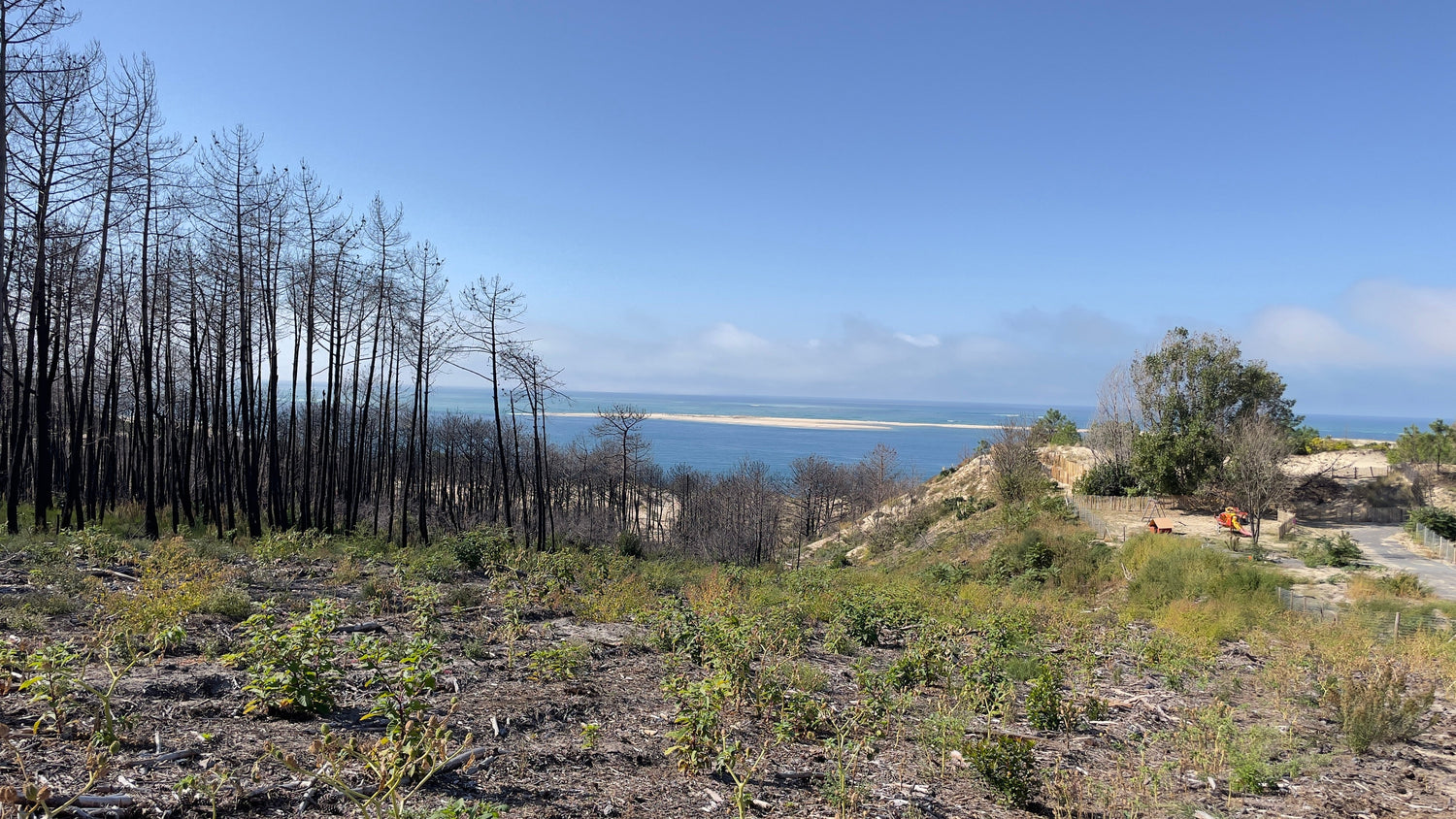
Imagine you’ve spent weeks planning your route through southern France. The van is packed, the campsites are picked out, and the Atlantic coast awaits. And then, right in the middle of peak season, that very same coast is shrouded in a blanket of smoke—while all around you, tens of thousands of people are forced to leave their vacation campsites.
This isn’t a disaster movie. This was July 2026 around Bordeaux and the Landes region.
In 2026, France experienced the worst wildfire season in its recent history. By the end of July, approximately 98,000 hectares had burned nationwide—a historic record, as confirmed by the French Ministry of the Interior.[^1] The massive fire in the Gironde near Saumos alone consumed about 42,000 hectares of forest and scrubland and forced some 167,000 people to flee. Across the entire region, some 220,000 people were forced to leave their homes or vacation spots at times.[^1] It wasn’t remote forests that were affected, but precisely the places where thousands of campers and vacationers were staying in the middle of the season: campgrounds, vacation resorts, and coastal areas.
One of the country’s best-known campgrounds, which had ranked among the top for years, lost over 250 bungalows in a single day.[^1] An Irish vacationer later summed it up: “Arrived with a packed suitcase, returned home with nothing.”
For anyone traveling through Southern Europe in a van, RV, or tent, this is more than just a headline. It’s a sign that the landscape of travel is changing. This article explains what’s behind it, what campers and van lifers can expect in the coming years—and how you can practically prepare for it.
Why Things Escalated in 2026—and Why It Wasn’t a Fluke
It’s tempting to dismiss a summer like this as an exception. The data tells a different story.
The Paradox: First Water, Then Fire
The disaster began, of all things, with wet weather. An unusually rainy spring caused vegetation to grow luxuriantly—more grass, more underbrush, more combustible material than usual. When the heat waves then set in, this very vegetation dried out into fine tinder within a matter of weeks. A wet spring thus acted not as protection, but as a fire accelerant in fast motion.
It is precisely this sequence—one extreme following another, with both reinforcing each other—that climate researchers are increasingly observing.
The actual driver: not El Niño, but climate change
Let’s clear up a common misconception right away: The Pacific climate phenomenon El Niño is not responsible for the heat and wildfires in Europe. The Potsdam Institute for Climate Impact Research (PIK) is unequivocal on this point—Europe is the continent least affected by El Niño.[^2] The driver is human-induced climate change. And it’s even accelerating: According to a PIK study from March 2026, the rate of warming over the past ten years has been around 0.35 °C per decade, compared to just under 0.2 °C on average from 1970 to 2015.[^3]
Météo-France, the French weather service, has quantified what this means specifically for travel destinations:[^4]
- France is projected to warm by +2.7 °C by 2050 (compared to 1900).
- In the Mediterranean region, the number of days with a very high fire risk will double —from around 40 today to over 80 days per year.
- The wildfire season will lengthen by one to two months, starting earlier in the spring and ending later in the fall.
- The risk is spreading northward into regions that were previously considered to be at low risk.
In terms of travel planning: The traditional “safe” off-season will become shorter, and regions that weren’t previously on people’s radar will become at risk.
What this means specifically for campers and van lifers
Understandably, most attention is focused on the fires themselves. But for day-to-day travel, it’s often the quieter consequences that matter most—the ones that affect your route and comfort long before any flames even appear.
1. Road closures and fire bans are becoming more common
When the risk of wildfires is high, prefectures and municipalities in Southern Europe can close access roads to forests and nature areas, ban open fires and barbecues, and restrict access to entire regions. In France, the daily “Météo des forêts” uses a four-level color scale (green to red) to provide information on the risk in each département.[^5] Anyone camping freely or heading to remote natural campsites should make it a habit to check these maps just as routinely as they check the weather forecast.
2. Water Is Becoming a Scarce, Expensive Resource
This is the issue that affects vanlifers most directly—and the one that is most underestimated. Droughts regularly lead to regional water restrictions: limited drinking water supply, closed or rationed water and waste disposal stations, and bans on “non-essential” water use. In particularly affected communities, this can mean that the usual water supply at the campsite is simply unavailable.
For self-sufficient travelers, this shifts the central question: no longer “Where is the next campsite?” but “How far will the water I have with me take me—and how little can I use?”
3. Heat Takes a Toll on People, Animals, and Equipment
Canicules—as the French call their heat waves—with temperatures exceeding 40 °C, are no longer a rare occurrence. This affects not only how comfortably you sleep in the van, but also how you keep food cool—and how odors and hygiene are managed inside the vehicle when it’s hot for days on end. Chemical cassette toilets, in particular, quickly reach their olfactory limits in sustained heat.
4. Travel Planning Is Becoming More Flexible Rather Than Rigid
Perhaps the most important consequence is a shift in mindset: Anyone traveling through Southern Europe in the future would be wise to plan with buffers and alternative routes. Setting a fixed route weeks in advance through a high-risk area is becoming riskier. Flexibility—both in terms of time and geography—is the new standard.
Self-sufficiency is no longer a luxury—it’s a matter of travel safety
Here, a shift in perspective is worthwhile. Self-sufficiency in a van has long been treated as a lifestyle choice: the beauty of being independent, the romance of staying off the beaten path. In the face of drought and supply shortages, however, it becomes something more tangible. Those who are independent of external water and waste disposal infrastructure simply have more leeway—and less stress—during a dry summer marked by road closures.
This applies to several areas: solar power, sufficient water supplies, and smart cooling. And one area that’s often overlooked, even though it’s relevant every day: the toilet.
Why the toilet issue suddenly becomes a water issue
Most portable toilet systems share an unpleasant commonality: they require water, chemicals, or both. A traditional cassette toilet flushes with fresh water and uses chemical additives, which must then be disposed of at special disposal stations. Both—the flushing water and the availability of disposal points—become scarce during a dry summer, precisely where you need them the least.
This is where a fundamentally different approach comes into play: the dry separation toilet.
The principle is as simple as it is effective: solids and liquids are collected separately rather than being mixed together, as in conventional systems. It is precisely this mixing that is the main cause of odor. When collected separately, there is hardly any unpleasant odor, and the system operates entirely without flush water or chemical additives.
For campers and vanlifers during a dry summer, this offers three very practical advantages:
- No flushing water needed. Your water supply stays where it’s needed: for drinking, cooking, and washing. The toilet doesn’t use any of it.
- No dependence on disposal stations. The solids are collected dry and with minimal odor and can be disposed of with regular trash—you don’t have to rely on the nearest supply and disposal station being open or chemical refills being available.
- Low odor even in hot weather. Because nothing ferments and no chemicals are involved, the interior remains significantly more pleasant than with a chemical system, even at 40 °C.
The BOXIO – TOILET is designed precisely with this in mind: a compact, waterless dry separation toilet in a practical size that fits in nearly any van, RV, and even small setups. No flush water, no chemicals, no reliance on disposal stations. If you want to expand your system modularly, you can combine it with compatible add-ons from the BOXIO modular system. The goal isn’t to sell you yet another gadget, but to give you a bit of real independence for the very summers that climate data is predicting for the coming years.
Handy Checklist: How to Travel Better Prepared in 2026 and Beyond
No matter which toilet system you use—these tips will make every trip to Southern Europe more relaxing:
Before the trip
- Plan your route with alternatives and time buffers; avoid a rigid, fixed itinerary through high-risk regions.
- Be familiar with the wildfire warning systems in your destination countries (in France: “Météo des forêts”).
- Calculate your water supply and consumption realistically; save every liter you can.
On the Road
- Check regional wildfire and heat warnings daily—just as a matter of course as checking the weather forecast.
- Take fire and barbecue bans seriously; nine out of ten fires are caused by humans, mostly through carelessness.[^5]
- Keep escape routes in mind: If you’re in a remote area, how will you get out quickly in an emergency?
- In extreme heat: Park in the shade, keep an eye on interior hygiene, and adjust food cooling.
In case of immediate danger
- Follow instructions from authorities and the fire department immediately; your car is not a safe place to take shelter during a fire.
- Emergency number in the EU: 112.
- Don’t wait until “maybe it’ll still be okay”—if in doubt, leave the area early.
Frequently Asked Questions (FAQ)
Will I still be able to camp in Southern Europe with peace of mind in 2026/2027? Yes—with proper planning. The risk varies greatly by region and season. Those who plan flexibly, use warning systems, and are self-sufficient can continue to enjoy Southern Europe. It’s not about giving things up, but about being prepared.
Is the heat in Europe related to El Niño? No. According to the Potsdam Institute for Climate Impact Research, Europe is the continent least affected by El Niño.[^2] Human-induced climate change—which is also accelerating—is responsible for the heat and wildfires.[^3]
Why is a dry separation toilet an advantage during a drought? Because it works without flush water or chemicals and doesn’t rely on special disposal stations. In a summer with water restrictions and closed supply and disposal points, this means greater self-sufficiency and less stress.
Doesn’t a separation toilet smell, especially in hot weather? The main cause of odor in conventional toilets is the mixing of solids and liquids. Because a dry separation toilet separates the two immediately and doesn’t use fermenting chemicals, it remains significantly less odorous even at high temperatures.
What do you do with the solids? The solids are collected dry and virtually odor-free in a separate container and can usually be disposed of with regular trash—without having to visit a chemical disposal station.
Conclusion: Preparation beats doing without
The “Fire Summer” of 2026 was a wake-up call, but not a reason to leave your van in the garage. The climate data is clear: heat, drought, and the risk of wildfires in Southern Europe are on the rise, and the travel season is changing. Those who take this seriously plan more flexibly, stay better informed, and become less reliant on infrastructure that may not be available in an emergency.
Self-sufficiency has thus evolved from a lifestyle statement into a tangible safety measure for travelers. And it starts with the seemingly insignificant details—with the question of how much water you really need, and for what. A waterless dry-separation toilet is one of the simplest ways to get by with less while still traveling in comfort—especially when it matters most.
Ready to make your next trip more self-sufficient? Discover BOXIO’s waterless dry-separation toilets and find the setup that fits your vehicle.